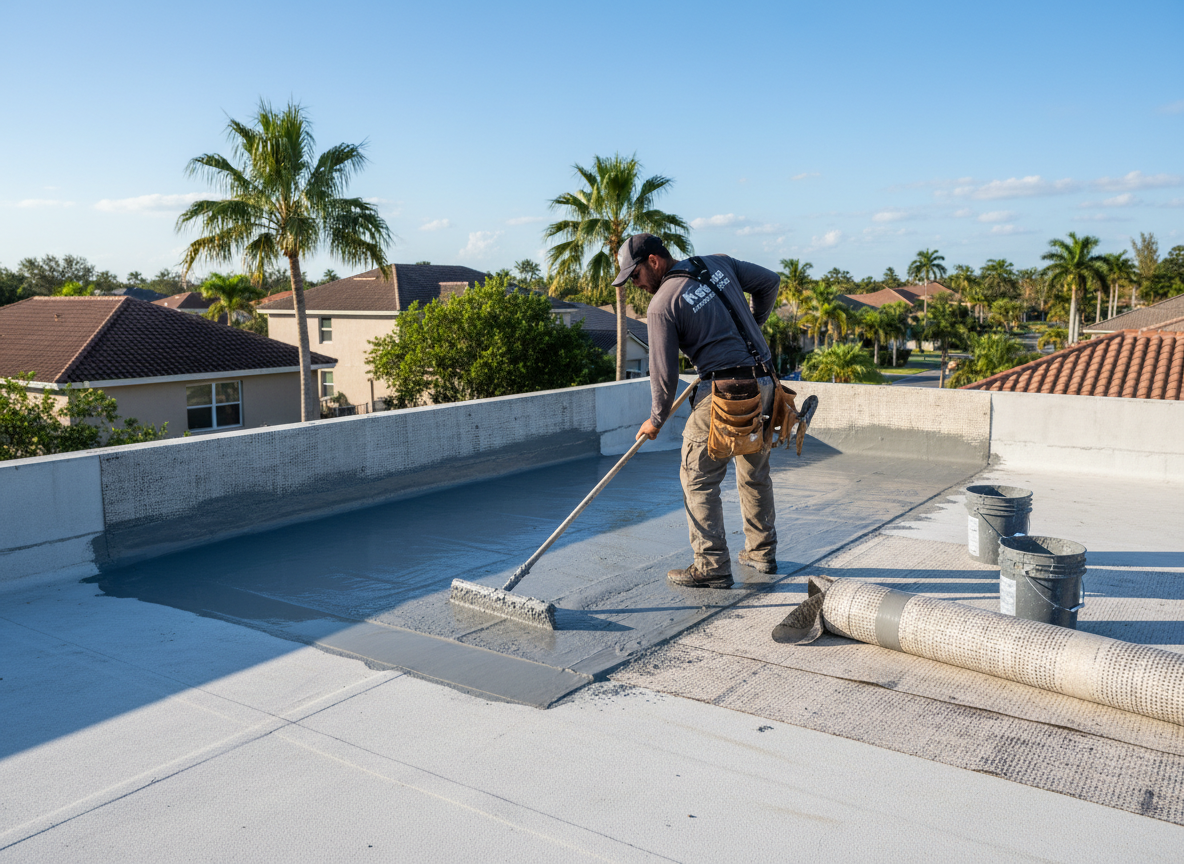
Cutler Bay homes, many built from the 1960s onward in Miami-Dade County, often feature concrete tile or built-up roofs that suffer from sealant breakdown around vents and valleys after repeated summer thunderstorms. Proper waterproofing starts with pressure washing to remove algae and loose granules, followed by application of elastomeric or polyurethane liquid membranes that stretch with thermal movement. These materials must meet Florida Building Code wind-uplift standards, especially on south-facing slopes exposed to Biscayne Bay gusts. Skipping the base coat or using incompatible primers leads to peeling within one storm season.
Edge cases appear frequently near the canal neighborhoods and older sections along Old Cutler Road where tree canopy shade keeps surfaces damp longer, promoting mold under the membrane. Technicians check for hidden deck rot by lifting a few tiles rather than relying on visual inspection alone. In low-slope sections common on ranch-style homes, a reinforced fabric scrim is embedded at seams to prevent water tracking under the coating during prolonged rain events. Homeowners who apply over existing failed coatings without removal see blisters form quickly once humidity spikes.
Regulatory notes include ensuring the chosen system carries a Miami-Dade County Notice of Acceptance for high-velocity hurricane zones. Improper overlap at drip edges or failure to extend the membrane six inches up walls creates the most common callback points. BravikMend always photographs the substrate condition before coating so owners can see exactly what is being sealed.
Technician insight
In Cutler Bay, the thing that catches most people out with roof waterproofing is how quickly afternoon thunderstorms dump water on older concrete tile roofs along the canals. Homeowners often forget that the south and east edges facing open water need extra reinforcement because wind-driven rain gets under the tiles faster than on inland streets.
Leak Repair After Summer Storms
A Cutler Bay homeowner saw ceiling stains following repeated downpours. Inspection revealed failed sealant around plumbing vents on a 1970s tile roof. The crew cleaned the surface, applied a reinforced liquid membrane over the affected section, and extended coverage to the nearest valleys. No further leaks occurred during the next rainy season.
How it works
- 1
Inspection and Assessment
Technicians examine the entire roof surface, flashings, and penetrations for existing damage or moisture intrusion while noting tile condition and slope variations typical in Cutler Bay.
- 2
Surface Preparation
Power washing removes dirt, algae, and loose material followed by repairs to any cracked tiles or deteriorated underlayment before primer application.
- 3
Membrane Application
Liquid waterproofing is rolled or sprayed in multiple coats with embedded reinforcement at seams and edges to handle wind-driven rain common in the area.
- 4
Final Inspection and Cleanup
The crew verifies uniform coverage, checks all terminations, and removes debris before leaving the site.
Pricing
Pricing depends on roof size, slope, and existing condition; upfront quotes given after on-site inspection.